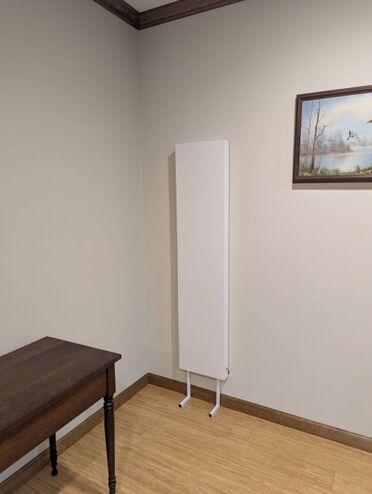

The worlds first flat woofer that does not take up space in a room, has no conventional box, mounts on or against a wall, is efficient and a very large low frequency sound source, there is no need for bass traps, which turns your listening room into a waveguide to solve bass room mode problems
The first time multiple subwoofers can be used in any room, the Thigpen Waveguide Woofer is an entirely new loudspeaker architecture, a new type of boxless flat monopole loudspeaker from Bruce Thigpen that improves efficiency, material use, weight, and size when compared to traditional loudspeakers. The home subwoofer less than 3-3/4 inches thick.
For the traditional home theater or home audio listening room, room modes are typically a big problem below about 200hz. Even though home audio woofers are very flat, used in a typical listening room, this is far from the case. Swings in frequency response at the listening position can be more than 30dB.
While you can subtract the peaks with DSP "room correction" software, these tools cannot correct the room mode dips in frequency response. There is a large amplifier power penalty for either a subtraction OR addition to correct these errors.

Fundamental principals in this new woofer technology and design:
1. The closer you are to a woofer the flatter the response,
2. If a woofer diaphragm is large enough, contrary to existing doctrine, you don't need a large box
3. The larger the surface area, the more directional the woofer becomes which concentrates energy, hence: flatter the response at the listening position.
4. A low profile large area woofer is much easier to use and install, the surfaces can be painted
5. The optimal acoustic position for woofers in a room rarely aligns with furniture placement, The Thigpen Waveguide Woofer makes this easy
This is the first time you can use multiple woofers in a listening room while taking up no space.
Thiele Small parameters represented a major step forward in loudspeaker design but completely overlook how a acoustically small low frequency source affects bass performance in a room. A small source radiates hemispherically resulting in exciting room modes in the most effective way essentially erasing bass quality and smooth response at the listening position.
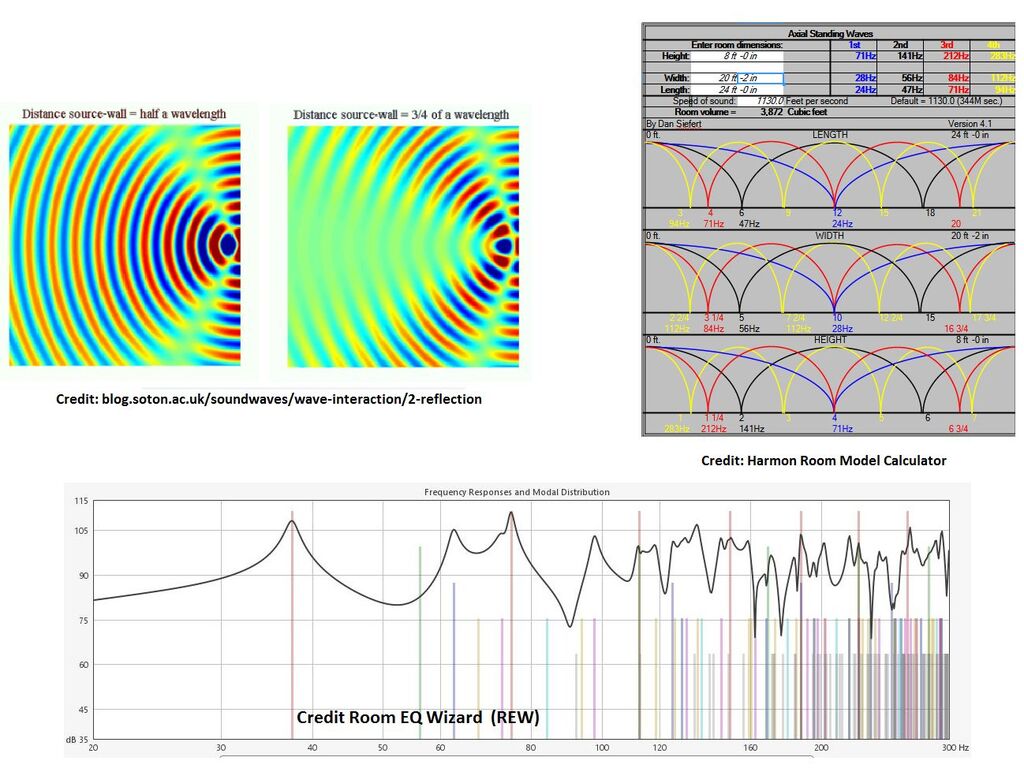
The Shroeder frequency, where woofers operate, is the frequency response region in a room where sound behavior changes from discrete, isolated low-frequency resonances (standing waves) to a diffuse blend of mid and high-frequency reflections. At the listening position, there will be dramatic peaks and near infinite dips in the amplitude response (not correctable with DSP) in this frequency region.
Typical domestic room walls are poor sound absorbers at low frequencies, long wavelengths reflect back and bounce around the room, where these waves coincide in phase they add about 6dB, where they collide out of phase the sound cancels almost completely which is why "room correction" is at best a peripheral solution, applying more power is a mistake creating problems elsewhere in the room. The solution is different at all points in the room.
From a subwoofer or full range speaker, the woofers frequency response below 200Hz in a room is rarely measured with any precision, this audio problem is hidden and if acknowledged, the claim is that you cannot hear it.
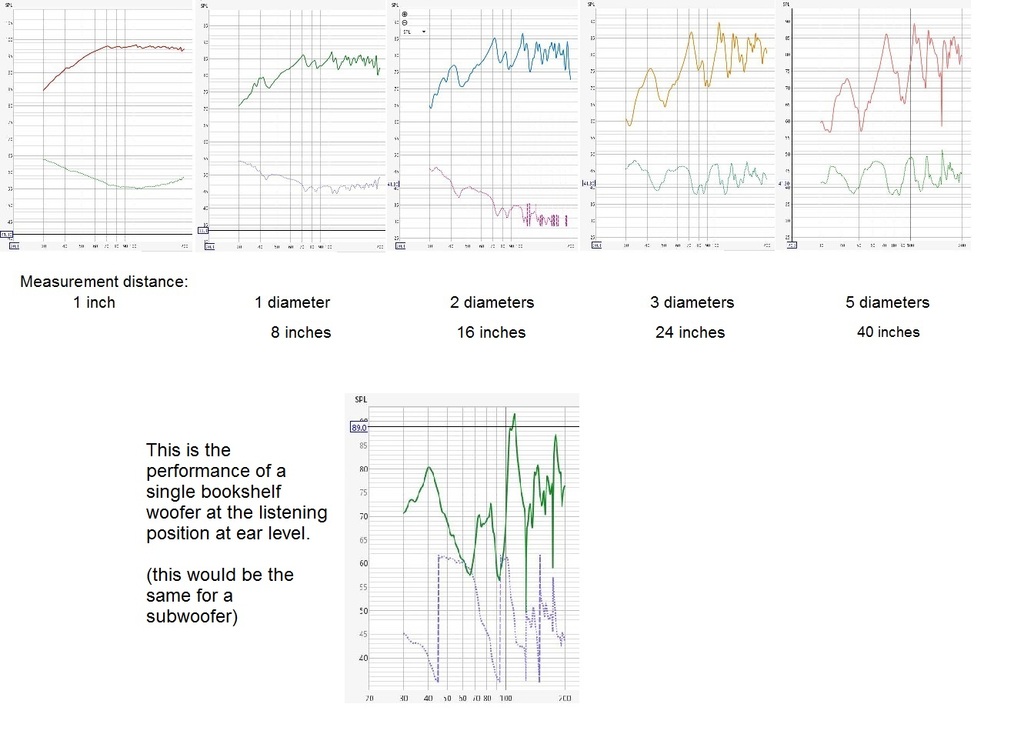
While woofer measurements are excellent near field (shown by companies and reviewers), the listening position results are dominated by the room:
Below is a woofer measurement in a typical listening room (25 x 15 x 8 feet or 7.6 x 4.5 x 2.4 meters). As you move the microphone away from the woofer the standing waves in the room (low frequencies reflecting off of walls) quickly take over the amplitude response through a woofers frequency range.
The Thigpen waveguide woofer is a new type of
loudspeaker where box volume is traded for
diaphragm area. This is facilitated with both a
moving magnet and moving coil configuration.
Diaphragm area is achieved by using parallel
horizontally opposed planes (which become the
speakers diaphragm or cone) of a stiff, light
weight material. The motor, a voice coil and
magnet span between adjacent planes, the voice
coil is attached to a front plane and the magnet is
attached to a rear plane, the force of the voice coil
simultaneously opposes the two planes. Two U.S. Patents
have been granted.
Conventional home loudspeakers or subwoofers radiate sound hemispherically, room modes originate from standing waves, bass frequencies are very difficult to absorb, so these long wavelengths reflect from walls in all directions and merge, some reflections are in phase, (louder) and in other areas of the room, sound waves are out of phase and completely cancel. DSP can correct areas where they sum, but energy is wasted trying to correct the frequency response where bass is cancelled.
One method is to take advantage of the large radiating area and low frequency directivity to effectively place the woofers acoustically close to the listener, this simple and elegant solution inherently flattens the frequency response.
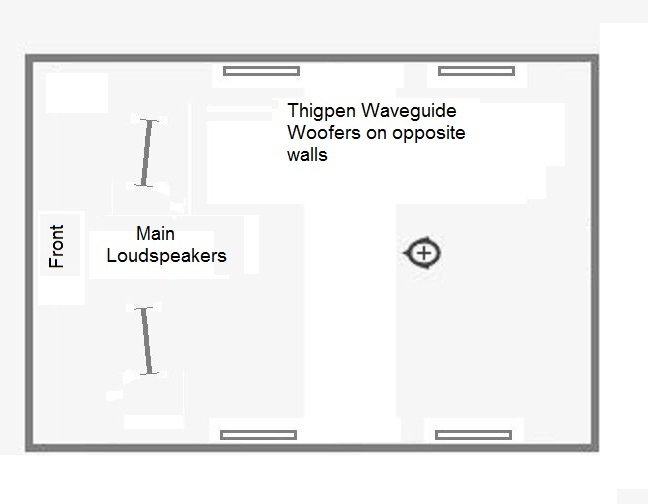
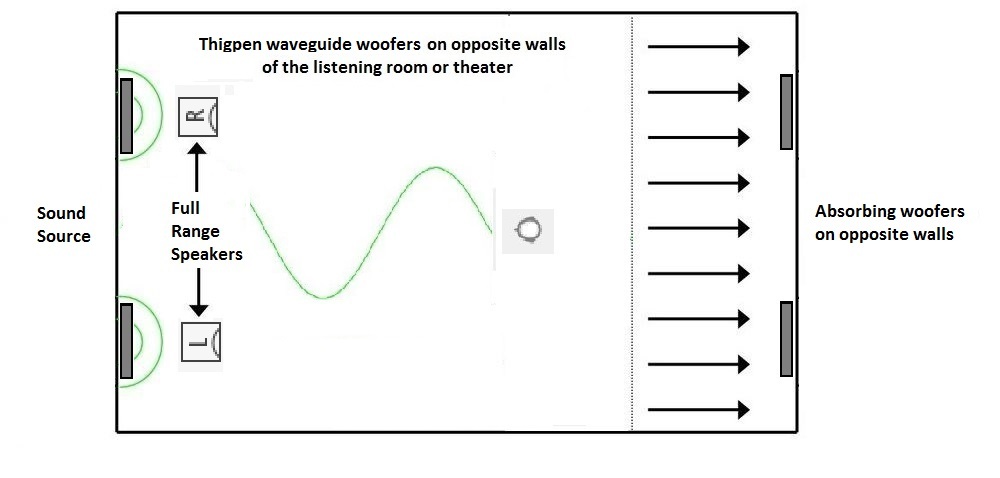
Shown below, the woofers are positioned to create a low frequency solution known as a double bass array. Here the sound travels from left to right, low frequencies travel down the room and are absorbed at the opposite end. There is an amazing improvement in both dips and peaks in the rooms low frequency response and control over decay rate with this approach.
Below are tools used to predict the frequency response of a loudspeaker or woofer in a listening.